V.
VIGHNESH KUMBHAR01 / 01

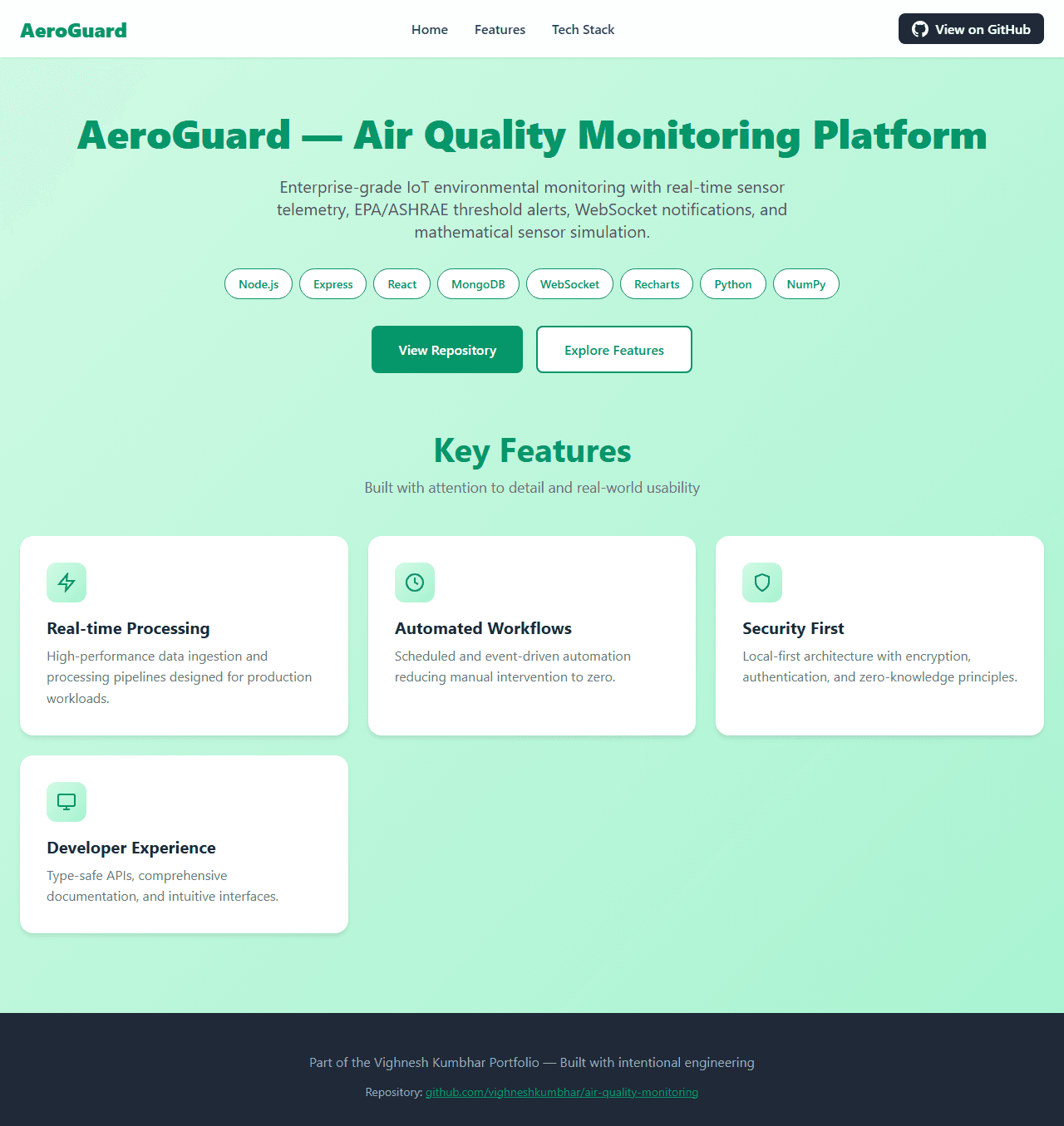
AeroGuard — Air Quality Monitoring Platform

Enterprise-grade IoT environmental monitoring platform with real-time sensor telemetry, EPA/ASHRAE threshold alerts, WebSocket notifications, and mathematical sensor simulation.

Active repository

AeroGuard — Air Quality Monitoring Platform source screenshot
AQI_MON
IOT / ENVCASE / 18
VERIFIED SOURCE MATERIALNode.js / Express / React

The premise.

AeroGuard is a full-stack environmental monitoring platform built as an Express/React monorepo. It ingests real-time sensor telemetry, evaluates air quality against EPA and ASHRAE standards, fires instant WebSocket alerts, and compiles downsampled trend metrics for interactive dashboards. Includes a high-fidelity Python simulator for environmental telemetry.

Air quality monitoring systems often lack real-time alerting, proper threshold mapping to standards, and realistic sensor simulation for testing. Existing solutions are either too simple or too expensive for portfolio/demo use.

How it is structured.

The repository evidence points to these observable boundaries and technologies:

  • Express + React monorepo with npm workspaces
  • Decoupled Controller-Service-Repository backend
  • MongoDB for time-series data with aggregation pipelines
  • WebSocket server for real-time alert broadcasting
  • React/Vite frontend with Recharts visualizations
  • Python simulator for environmental telemetry generation

From idea to system.

  • Real-time telemetry ingestion with per-device API tokens
  • Multi-level EPA/ASHRAE threshold alert system
  • WebSocket-based instant alert notifications
  • Dynamic time-series downsampling (15m, 1h, 1d intervals)
  • Mathematical sensor simulator with diurnal cycles and AR(1) noise
  • Responsive dashboard with device status and alert resolution
Node.jsExpressReactViteMongoDBMongooseJoiWebSocketRechartsTailwind CSSLucide ReactPythonNumPy

The difficult parts.

  • Decoupling ingestion from alerting without message loss
  • Mapping raw particulate values to EPA breakpoints accurately
  • Simulating realistic cross-variable environmental correlations
  • WebSocket connection management at scale

What can be said honestly.

  • Functional telemetry ingestion with schema validation
  • Threshold alerts mapping to EPA/ASHRAE standards
  • WebSocket alerts broadcasting to connected clients
  • MongoDB aggregation for downsampled analytics
  • Python simulator generating realistic sensor data

Environmental monitoring requires careful threshold semantics — raw values need domain-standard interpretation. Simulation is as important as the monitoring stack for demos.